

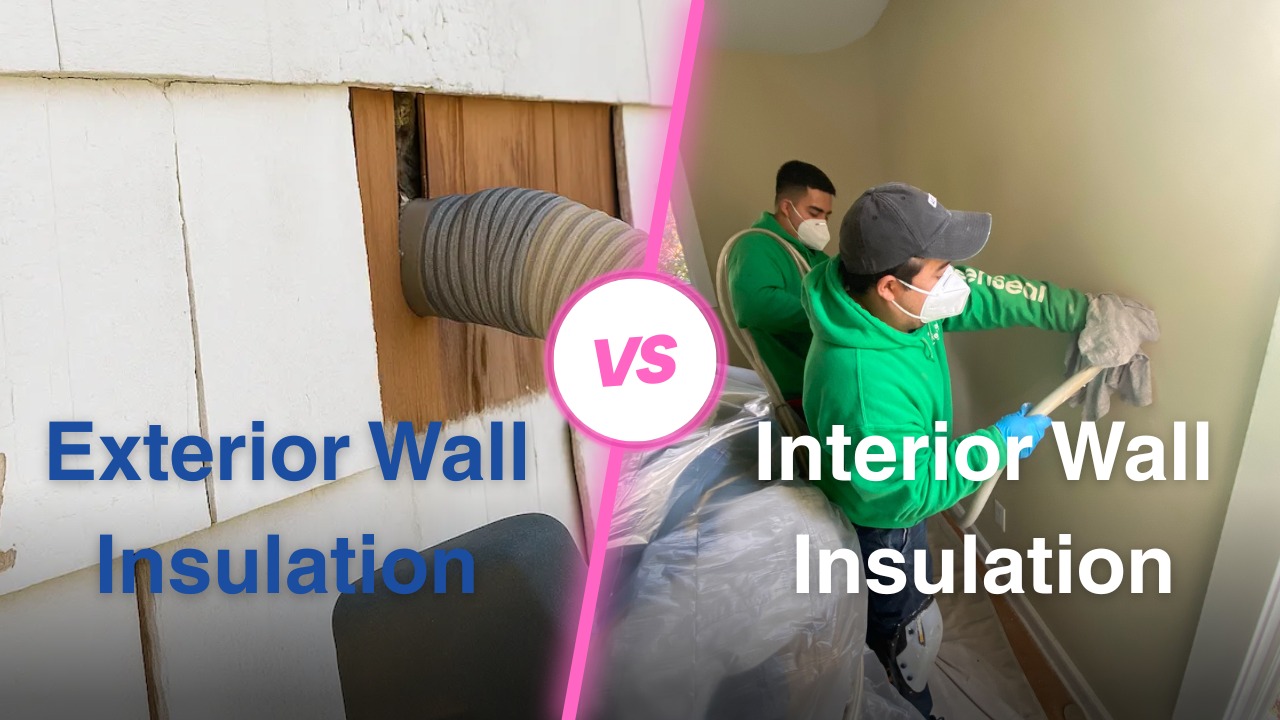

Struggling with soaring energy bills, cold walls in winter, and overheated rooms in summer? You’re not alone. Homeowners often face the pain point of low comfort and high running costs, while being unsure which path to take for wall insulation.
So what’s better, exterior wall insulation vs. interior wall insulation?
The answer depends on your building type, budget, renovation plans, and performance goals. Still, in many cases exterior application wins for thermal performance and durability, while interior insulation may win for short-term cost and convenience.
What are we comparing?
Exterior wall insulation refers to installing insulating material on the outside face of the building’s external wall structure, then usually covering it with a render, cladding or siding. This adds a layer over the existing wall and often acts as a protective weather-and-thermal envelope.
Interior wall insulation involves applying insulation on the inside face of the external wall. This can be via fixing boards, building a new stud wall with insulation between, or insulating plaster finishes on the inside of the wall.
Why the question matters
When picking insulation, you’re really choosing how your home’s thermal shell behaves. Important factors include:
- How much usable space you will lose (interior walls move inwards).
- How much you’ll interrupt everyday life or redesign surfaces.
- How the wall assembly handles moisture and thermal bridging.
- How the insulation interacts with external weather, noise, appearance and future maintenance.
- How the installation cost and long-term savings work out.
If your insulation is done poorly, you might end up with mould, damp, and reduced R-value just when you thought you were upgrading. For example:
Wall Insulation Materials & R-Value Basics
Before comparing location choices, some fundamentals:
Wall insulation materials
Common options include:
- Rigid foam boards (EPS, XPS) are especially suitable for exterior.
- Mineral wool or fiberglass batts in stud cavities (typical for interior).
- Spray foam (less common for full wall retrofits unless structural work).
- Insulating renders for exterior systems.
Insulation R-value & thickness
- Insulation R-value is a measure of how well a material resists heat flow. Higher is better.
- For exterior walls in many climates, target R-13 to R-23 is cited.
- Insulation thickness must be sufficient to achieve the R-value, but also installation location, wall assembly and thermal bridging affect effective performance.
Exterior vs Interior Wall Insulation: Pros and Cons
Exterior wall insulation
Advantages
- Improves the wall envelope so the entire external wall becomes part of the insulated envelope (less thermal bridging) and helps keep the mass of the wall inside so it can moderate temperature swings.
- Does not reduce internal floor space. It preserves the internal room dimensions.
- Provides an opportunity to upgrade the exterior finish (cladding, render) and weatherproofing at the same time.
- Often improves noise insulation, reduces drafts and enhances comfort.
- Better long-term performance in preventing condensation inside the wall assembly if correctly applied.
Disadvantages
- Higher upfront cost: materials, exterior scaffolding, finishing.
- If the building is complex (adjacent buildings, heritage facade, limited access) it can be difficult or require special permissions.
- Exterior details (windows, doors, eaves) need extra care to avoid cold bridges or moisture problems.
- If moisture issues are present in the wall or structure, exterior insulation must be installed carefully, or it can trap moisture.
Interior wall insulation
Advantages
- Typically, a lower initial cost for material and labor (especially if you’re already doing internal upgrades).
- Less disruption to external appearance, good for heritage buildings or where planning constraints exist. yesenergysolutions.co.uk
- Installation may be simpler for just one or two rooms.
Disadvantages
- Interior space is eaten up: wall thickness increases, and room sizes slightly reduce.
- Big disruption inside: removing skirting, sockets, possibly decor, and rerouting services.
- The wall mass remains outside the insulation envelope, meaning that thermal bridging and night-time radiation may reduce comfort/performance.
- Potential for moisture problems if vapor movement is not controlled properly, especially in cold climates.
- Harder to retrofit incrementally: finishing the interior can get expensive after the insulation.
Practical Decision Matrix – Which To Choose?
Here are factors to help you choose the best solution for your home.
| Factor | Favor Exterior Insulation | Favor Interior Insulation |
| Building type & façade | Solid walls, old building with poor cavity; want external refresh | Building in conservation area (external appearance must remain) |
| Space retention priority | Want full internal room size preserved | Room sizes less critical; only upgrading a few rooms |
| Budget/front-cost constraints | Budget allows more upfront spend for longer term gain | Want lower up-front cost or gradually upgrade |
| Access to exterior walls | Good access, no adjoining buildings blocking works | Poor exterior access, existing cladding/siding in good condition |
| Interior disruption tolerance | Prefer minimal interior disruption | Comfortable with interior works, redecorating |
| Moisture/thermal bridging risk | Want best performance and durability across wall assembly | Accept somewhat reduced performance with careful detailing |
| Long-term value / appearance | Want façade upgrade, noise reduction, comfort | Internal refit more important than façade |
Insulation Installation Process – What to Expect
Let’s outline what each path typically involves so you can gauge disruption, cost and time.
Exterior wall insulation installation process
- Inspect and repair any existing external wall defects (damp, cracks, substrate).
- Fix insulation boards (rigid foam or mineral wool) to the exterior wall surface, either mechanically or with adhesive.
- Provide a weather‐resistant outer layer: render, cladding, brick slips, etc.
- Detail interfaces: around windows, doors, eaves, pipe penetrations to avoid cold bridges.
- Re-attach or update gutters, fascias, external trims as required due to added thickness.
- Finish site clean, possibly repaint or touch up façade.
Disruption: Exterior works can largely be done while interior is live, but scaffolding may affect neighbours, access, views.
Interior wall insulation installation process
- Begin inside the room: remove skirting boards, sockets, possibly existing finishes where insulation will go.
- Add insulation: either fix rigid boards to existing wall, or build new stud wall filled with insulation between.
- Add vapour control layer if required, fix plasterboard, tape, and finish surfaces.
- Re-route or adjust services (electrical sockets, switches) due to changed wall thickness.
- Redecorate walls, reinstall skirting/trim/flooring if moved.
Disruption: Interior rooms are out of action during works, furniture must be moved, finishing cost adds up.
Performance Considerations – R-Value, Thermal Bridging & Moisture
You’ll see that the thicker (or more performant) your insulation, the higher the R-value and better the heat resistance.
Moisture & condensation risk
Proper detail is critical. Exterior insulation shifts the dew-point outward and helps keep the wall warm and dry.
Interior insulation may trap moisture if vapor control is inadequate, particularly in colder climates.
Space & usability trade-off
Interior insulation reduces internal space and complicates fixing heavy items on walls.
Cost & Value
- Exterior insulation carries a higher upfront cost (material, scaffolding, finishing) but often achieves better long-term savings and may add value to the home via improved façade and comfort.
- Interior insulation is cheaper initially and more incremental, but may have shorter payback and less performance upside.
- When estimating the best insulation for walls, look at the payback period, energy bill savings, comfort gain, and potential property value uplift.
The overall R-value of a wall or ceiling will be different from the R-value of the insulation itself because heat flows more readily through studs, joists, and other building materials. So installing insulation is one thing, but how it integrates into the assembly matters.